Case 26
| Case Number | 26 |
| Charge | Theft |
| Defense Attorney Present | No |
| Interpreter Present | Yes |
| Racialized Person | Yes |
| Outcome | Probation |
A young man is on trial for theft. During his trial, he is informed that his sentence will be high because he had a knife at the time, though the evidence does not show that it was used during the offense. The judge threatens the defendant with jail time. Without a lawyer to consult, he appears to have little choice but to accept the harsh sentence and put up with the judge’s insinuations that he steals for the purpose of reselling – just like unnamed “others” the judge refers to.
This case demonstrates how the criminal court sees itself as an enforcer of the migration system. Prior to the trial, the judge had made arrangements with the migration authorities and she appears to judge the defendant more harshly in his criminal case for alleged administrative issues related to his migration status. The case also shows how possession of a knife escalates the severity of punishment, even when it is clear that the knife was not used during the alleged offense. Courts assume people with knives are violent, failing to recognize that for many who are houseless or experiencing other difficulties, knives serve as self-defense or as a necessary day-to-day tool. Courts are influenced by the moral panic over “knife crime”. In this case, the court threatens jail, which causes the defendant palpable anxiety. The case illustrates the real violence inherent in the “migrant crime” narrative as well as its offshoots, and how they impact migrantized people’s experiences with the punishment system.
The judge starts the case by commenting on how police intervention was required to secure the defendant’s appearance at trial, suggesting that the defendant had purposely evaded being served notice. But it is not clear from the exchange that the defendant was even aware of the problem with his registration before. The judge proceeds to hand him a summary proceeding order (Strafbefehl) for another theft case, explaining it is legally in effect despite the fact that he did not receive it earlier.
After reading the charges for the current case, the defendant admits he stole perfume for his wife. The court shows a photograph of the knife found on him during his arrest. The man explains that he uses it at home in the kitchen and was unaware that he had it on him at the time of the offense. The judge tells him that carrying a knife while stealing elevates the charge to theft with a weapon. She adds “I also cut fruit and meat at home but it would not occur to me to take a knife with me”.
Switching gears, she tells the defendant to look at his summary proceedings order and asks him, ”Do you ever think about how you will pay this?” He affirms this and asks if he can pay in installments. The judge, smiling, explains that now they are dealing with theft with a weapon and that she does not see reasons for leniency. She lists mitigating factors, emphasizing that his situation does not qualify because he did not steal what she would consider necessities.
The prosecutor argues the defendant knowingly carried the knife and therefore demands a long prison sentence to be served on probation. The judge decides to reduce the proposed sentence by two months but otherwise shares the prosecution’s opinion that a harsh sentence is warranted. She says that it is better for him to be placed on probation rather than incarcerating him because he would be able to work, which would be better for his integration. She warns that reoffending will lead to prison, stressing that if he goes to jail, his child will not recognize him anymore upon release. She says she doubts that the perfume was really for his wife and that she believes he tried to make money “as the others do”. She ends the trial with a list of reprimands to the defendant: to avoid crime, to open his mail, and to register his address.
Cases from our archive
Case 39
A young woman experiencing homelessness is sentenced to 90 days of fine payment for supplying drugs. The conviction will not appear on her Certificate of Good Conduct (Führungszeugnis), which was important to her, but the court punishes her with a high fine even as it acknowledges she was supplying drugs because of her poverty.
Case 38
This case concerned a person currently serving a prison sentence being found with a small quantity of cannabis, an amount that would usually not be prosecuted in Berlin. The person is brought to the court from the prison to stand trial and is sentenced to a €30 fine.
Case 37
A white defendant with access to private counsel is sentenced to a fine for possession of 15 small bags of cannabis, with a total amount of cannabis above the legal threshold for a “low quantity” (nicht geringe Menge). The court accepts her account that the cannabis was for personal use, and justifies the relatively mild sentence with a favorable assessment of the defendant living a “normal bourgeois life”.
Case 36
In a case heard shortly before the 2024 law change that legalized certain forms of cultivation, possession, and acquisition of cannabis in Germany, a young man is accused of selling cannabis via car delivery. Despite the relatively low quantity of cannabis found and the person having childcare responsibilities and financial difficulties, the prosecution recommends a sentence of over a year in prison. In the end, the judge imposes a long probation sentence, severe in light of the impending opening of the cannabis market.
Perspectives

Structures of Anti-Roma Racism: An interview with Amaro Foro’s Valerie Laukat
Justice Collective
Courtwatching often reveals the deep-rooted structures of anti-Roma racism in German public institutions and society. In this interview, we find out more about how anti-Roma racism is embedded in broader structures of exploitation and exclusion – and how to work towards transformative change.
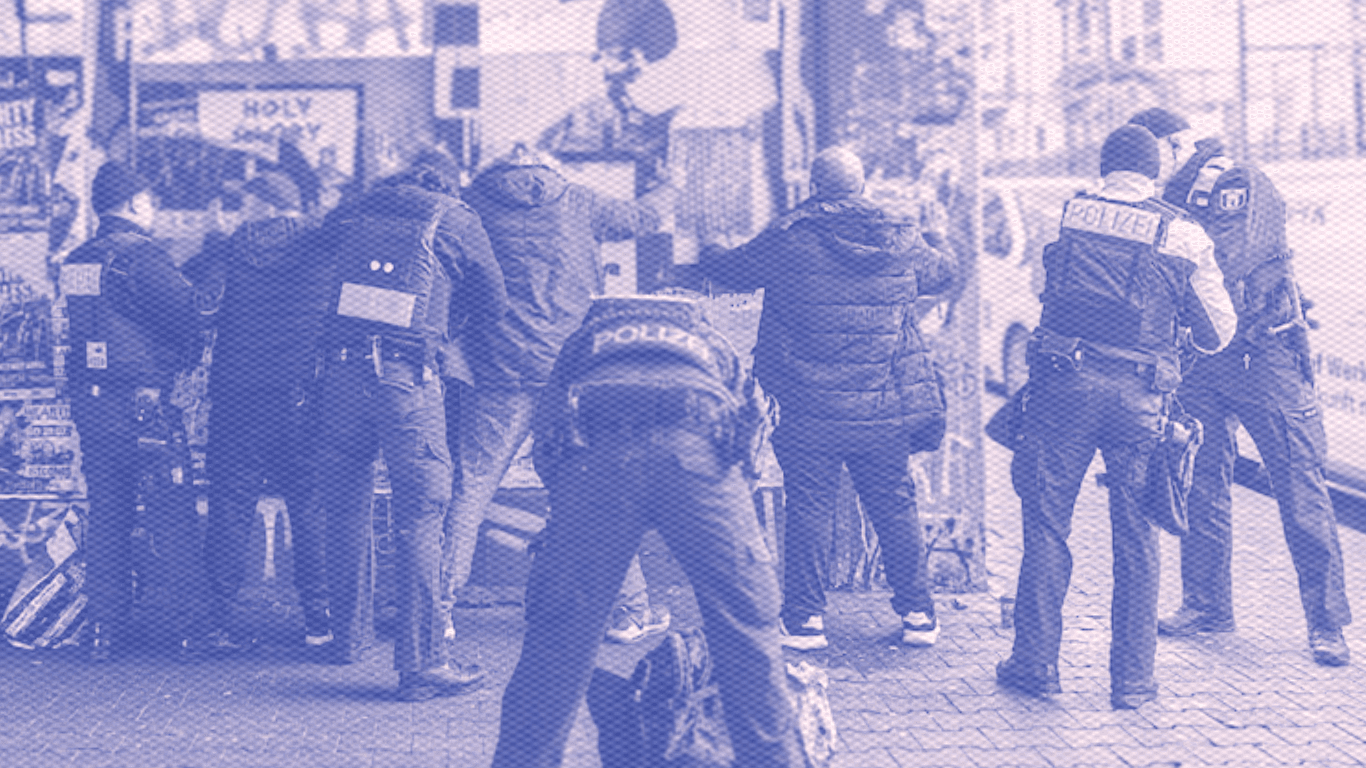
Court observations show: moral panic around “knife crime” fuels criminalization
Justice Collective
A closer look at criminal court cases involving knives reveals cases far away from the media image of violent attackers. To paint a more realistic picture, we offer case reports, analysis, and a discussion event.

Criminalized: The Anti-Migration Debate Fuels and Legitimizes Systemic Racism
Anthony Obst, Justice Collective
Fueled by media coverage of isolated violent incidents, a troubling consensus has emerged that presents increasingly severe law-and-order measures as the only solution to perceived insecurity supposedly caused by immigration. This obscures the violent realities of racist criminalization.

Refugees in Germany: The omnipresent border regime
Britta Rabe, Grundrechtekomitee
Even after surviving perilous journeys to reach the EU – which can include pushbacks, beatings, and torture – refugees face an exclusionary system within Fortress Europe that makes their arrival difficult or even impossible. The EU border regime extends all the way into Germany, permeating society invisibly yet tangibly for those who are excluded.