Case 23
| Case Number | 23 |
| Charge | Fraud |
| Defense Attorney Present | Yes |
| Interpreter Present | Yes |
| Racialized Person | Yes |
| Outcome | Fine |
A woman comes to Germany for health treatment, her family collecting thousands of euros to prepay costs and secure a visa. A federal agency accuses her of forging identity documents. Despite the prosecution admitting lack of evidence for intentional deception and requesting acquittal, the court sentences her to a harsh fine, jeopardizing both her stay in Germany and her health.
The judge openly and wrongly assumes the woman to have immigrated illegally, which speaks to the deeply engrained nature of racist prejudice in Germany and its punishment system. Clearly, this prejudice affects how he approaches the case: Even the lack of evidence conceded by the prosecutor does not sway the judge and the defendant’s medical situation appears to play no role in his assessment. Moreover, the case shows how courts act as a mechanism for migration control: by imposing criminal penalties, they create additional barriers for migrants and reinforce the precarity of their legal status in the country, acting as deterrence.
The defendant enters the courtroom accompanied by her lawyer and an interpreter. During the hearing we learn that she had come to Germany about two years prior to the trial to receive essential health treatment after unsuccessful attempts in her home country. Her family had collected thousands of euros to cover her treatment costs upfront, allowing her to obtain a visa.
The prosecution accuses her of forging an identity document and using it to present a false identity to a federal ministry. The defendant’s lawyer explains the circumstances of her entry into Germany and how she obtained the document, which a forensic report identified as forged. The lawyer states that the embassy in her home country recognized the document, giving the woman no reason to believe it might be forged.
The judge expresses doubt about this account, incorrectly assuming her visa application had been rejected. The lawyer corrects him, stating that the application was approved on medical grounds.
Both the prosecution and defense plead for an acquittal, but the judge insists that the forgery is proven and that he has no doubt about the defendant’s intent to deceive. The lawyer angrily declares he will appeal the decision.
Cases from our archive
Case 39
A young woman experiencing homelessness is sentenced to 90 days of fine payment for supplying drugs. The conviction will not appear on her Certificate of Good Conduct (Führungszeugnis), which was important to her, but the court punishes her with a high fine even as it acknowledges she was supplying drugs because of her poverty.
Case 38
This case concerned a person currently serving a prison sentence being found with a small quantity of cannabis, an amount that would usually not be prosecuted in Berlin. The person is brought to the court from the prison to stand trial and is sentenced to a €30 fine.
Case 37
A white defendant with access to private counsel is sentenced to a fine for possession of 15 small bags of cannabis, with a total amount of cannabis above the legal threshold for a “low quantity” (nicht geringe Menge). The court accepts her account that the cannabis was for personal use, and justifies the relatively mild sentence with a favorable assessment of the defendant living a “normal bourgeois life”.
Case 36
In a case heard shortly before the 2024 law change that legalized certain forms of cultivation, possession, and acquisition of cannabis in Germany, a young man is accused of selling cannabis via car delivery. Despite the relatively low quantity of cannabis found and the person having childcare responsibilities and financial difficulties, the prosecution recommends a sentence of over a year in prison. In the end, the judge imposes a long probation sentence, severe in light of the impending opening of the cannabis market.
Perspectives

Structures of Anti-Roma Racism: An interview with Amaro Foro’s Valerie Laukat
Justice Collective
Courtwatching often reveals the deep-rooted structures of anti-Roma racism in German public institutions and society. In this interview, we find out more about how anti-Roma racism is embedded in broader structures of exploitation and exclusion – and how to work towards transformative change.

Criminalized: The Anti-Migration Debate Fuels and Legitimizes Systemic Racism
Anthony Obst, Justice Collective
Fueled by media coverage of isolated violent incidents, a troubling consensus has emerged that presents increasingly severe law-and-order measures as the only solution to perceived insecurity supposedly caused by immigration. This obscures the violent realities of racist criminalization.
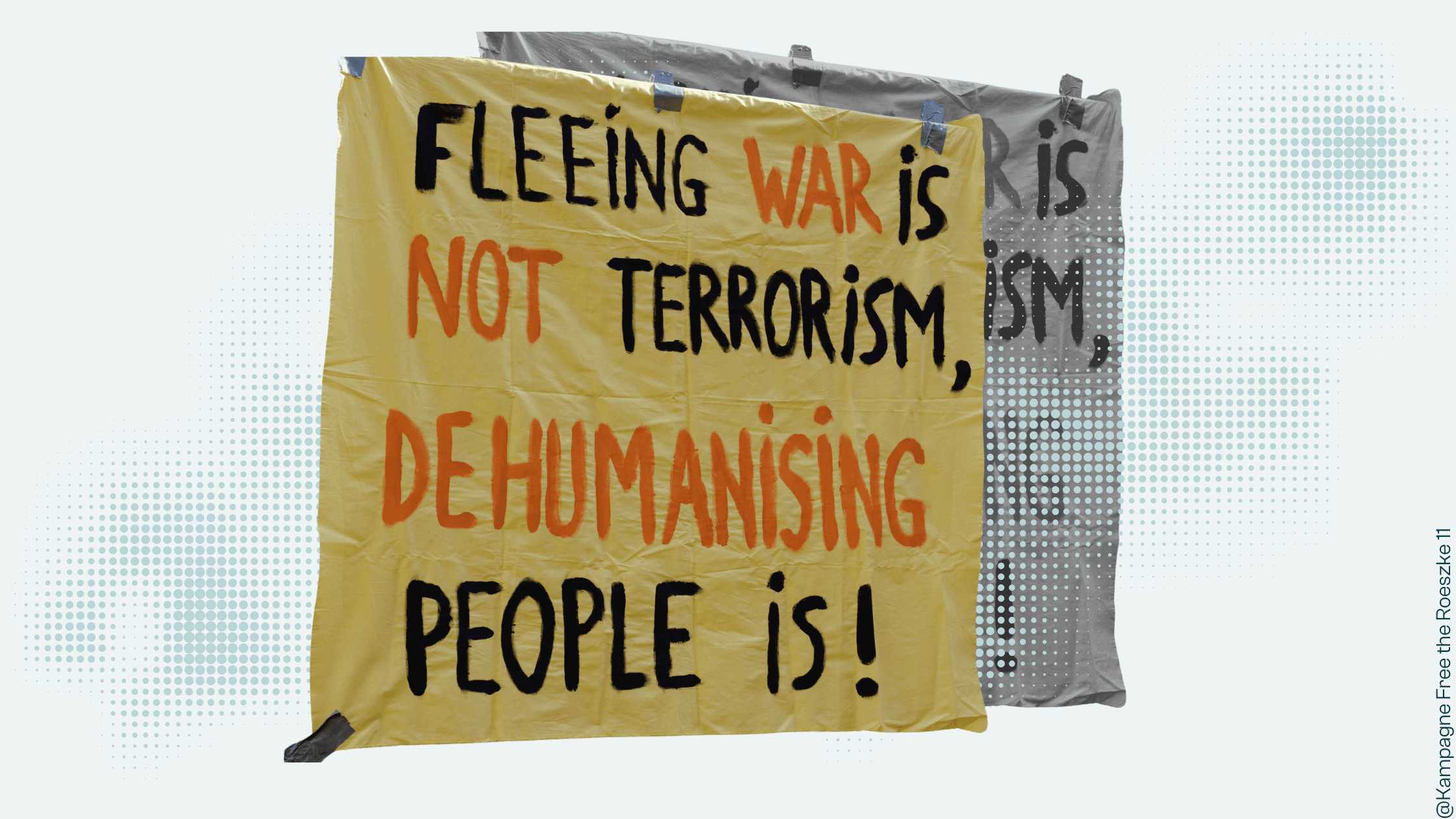
Refugees in Germany: The omnipresent border regime
Britta Rabe, Grundrechtekomitee
Even after surviving perilous journeys to reach the EU – which can include pushbacks, beatings, and torture – refugees face an exclusionary system within Fortress Europe that makes their arrival difficult or even impossible. The EU border regime extends all the way into Germany, permeating society invisibly yet tangibly for those who are excluded.