Case 18
| Case Number | 18 |
| Charge | Theft |
| Defense Attorney Present | No |
| Interpreter Present | Yes |
| Racialized Person | Yes |
| Outcome | Other Outcomes |
A young woman’s theft case in fast-track court is dismissed, but only on the condition she pays a fine. She says security footage would exonerate her, but the court does not want to extend the proceedings to take evidence and seemingly presumes the woman’s guilt.
In this case, the court would have to take evidence to be able to convict. However, in an attempt to save time, the judge and the prosecutor settle on imposing a non-criminal fine and officially dropping the charges (which is possible under § 153a StPO). Whether or not the accused would be able to pay is not discussed in setting this fine.
Regardless of whether the allegations against the woman are true, this case shows how gender, poverty, and race intersect to criminalize mothers in specific ways. In this case, a woman is accused of stealing basic necessities. That she may not have enough money to buy them should not be an indictment of her but rather of gendered racial capitalism.
Even though the judge and the prosecutor act like they are doing the woman a favor by dropping the case, they make it clear that they are acting in the self-serving interest of saving time. In addition, we can see how court procedures can make punishment a foregone conclusion. Though the woman is not officially convicted, a fine of multiple hundred euros does constitute punishment and was imposed because the court assumes the woman’s guilt. In this way, § 153a StPO, supposedly a provision that allows for leniency, is a backdoor way to punish.
The accused woman in this case is a young mother of three children. She is unrepresented by counsel and has an interpreter. Throughout the proceedings, the interpreter repeatedly responds directly to the court’s questions rather than interpreting so that the woman understands what is happening and can reply herself.
The court asks whether the woman works, to which she responds that she does not. The court assumes that she therefore receives social benefits (Bürgergeld), though the judge does not clarify that this is, in fact, the case. As the prosecutor reads out the charges, we learn that the woman is accused of stealing dietary supplements in low quantities.
The woman denies the allegations and explains that she scanned the items at the automatic checkout and that she did not know why they did not show up on her receipt. At the time of the offense, she had asked store personnel to check the video footage, which would confirm her account. They refused and called the police. The judge refers to the police report from the incident and says that the woman had told the police that the items in her bag were paid for at another store. The woman says that she was misunderstood and that she did try to buy these items at the store in question but that they were not read by the automatic checkout. There is no mention of an interpreter being present when she spoke with the police.
The judge and prosecutor discuss. They would have to take evidence to be able to convict. The prosecutor does not want to delay and so they settle on imposing a non-criminal fine and dropping the charges (which is possible under § 153a StPO). He first suggests €400; the judge counters with €300, which they agree to. The woman’s ability to pay is not discussed in setting this fine. The judge also mentions that the woman can get a payment plan but will have to request that later. As the defendant is about to leave, the prosecutor yells after her, “Another thing to take from this is that this was an exception! Next time we won’t be so kind as to settle with money.”
Cases from our archive
Case 39
A young woman experiencing homelessness is sentenced to 90 days of fine payment for supplying drugs. The conviction will not appear on her Certificate of Good Conduct (Führungszeugnis), which was important to her, but the court punishes her with a high fine even as it acknowledges she was supplying drugs because of her poverty.
Case 38
This case concerned a person currently serving a prison sentence being found with a small quantity of cannabis, an amount that would usually not be prosecuted in Berlin. The person is brought to the court from the prison to stand trial and is sentenced to a €30 fine.
Case 37
A white defendant with access to private counsel is sentenced to a fine for possession of 15 small bags of cannabis, with a total amount of cannabis above the legal threshold for a “low quantity” (nicht geringe Menge). The court accepts her account that the cannabis was for personal use, and justifies the relatively mild sentence with a favorable assessment of the defendant living a “normal bourgeois life”.
Case 36
In a case heard shortly before the 2024 law change that legalized certain forms of cultivation, possession, and acquisition of cannabis in Germany, a young man is accused of selling cannabis via car delivery. Despite the relatively low quantity of cannabis found and the person having childcare responsibilities and financial difficulties, the prosecution recommends a sentence of over a year in prison. In the end, the judge imposes a long probation sentence, severe in light of the impending opening of the cannabis market.
Perspectives

Structures of Anti-Roma Racism: An interview with Amaro Foro’s Valerie Laukat
Justice Collective
Courtwatching often reveals the deep-rooted structures of anti-Roma racism in German public institutions and society. In this interview, we find out more about how anti-Roma racism is embedded in broader structures of exploitation and exclusion – and how to work towards transformative change.
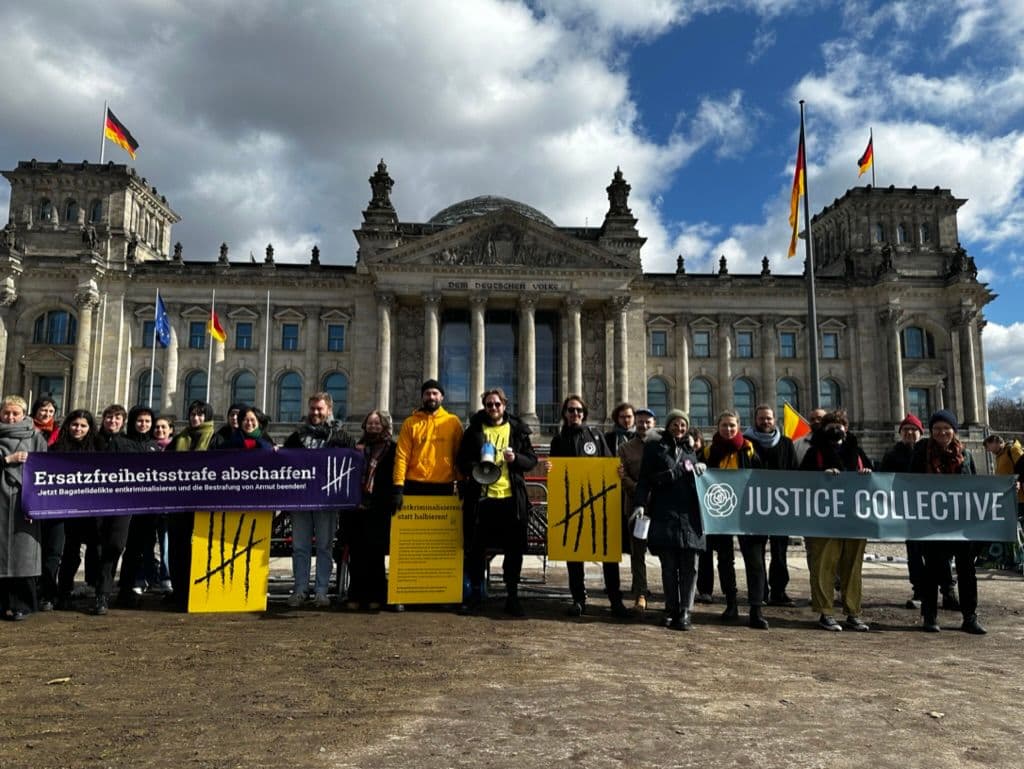
Jailing people for unpaid fines is about more than punishing poverty
Carmen Grimm, Bündnis zur Abschaffung der Ersatzfreiheitsstrafe
In Germany, people are incarcerated every day because they cannot pay a fine. Critics of this practice known as “Ersatzfreiheitsstrafe” are in agreement that a person’s economic status should not determine the severity of their sentence. The Coalition for the Abolition of Debtor’s Prisons agrees with this view – and urges critics to take a broader view attentive to the links between poverty and racism.