Case 17
| Case Number | 17 |
| Charge | Theft |
| Defense Attorney Present | No |
| Interpreter Present | Yes |
| Racialized Person | Yes |
| Outcome | Fine |
The court sentences an older woman to a hefty fine for theft from a supermarket. As the court hands down the sentence, court security moves in to arrest the woman. She has an outstanding warrant because of an unpaid fine on a prior case, for which they will take her to prison immediately.
The atmosphere in the courtroom is tense from the beginning. Our courtwatchers noticed that there is extra security personnel in the room but we did not understand why at first. The woman was not provided an attorney, which would usually mean that she does not face prison.
The trial illustrated the cruel violence of the criminal legal system. This struck us especially when we learned that all along the authorities in the room knew that the woman was about to be handcuffed and taken to prison. The judge sentenced her knowing she likely will spend time in prison for this case as well when she is unable to pay her fines.
In this case, Justice Collective was able to intervene and pay her fine and court costs so that she could avoid prison. While we spent nearly two hours navigating the paperwork and lining up funding, the woman was held by police without an interpreter.
An older woman arrives at her hearing with her adult son in the audience. She moved to Germany some years ago and says she receives social benefits as income. She is accused of stealing from a grocery store. The hearing takes place without a defense attorney, and the interpreter translates intermittently.
To start, the judge questions the woman about how to spell her name (“sometimes we get aliases”), whether she is learning German, and why she came to Germany. The judge says that the defendant’s stated reason, fleeing domestic violence, is not sufficient reason to come to Germany. (The judge’s claim is false. Some time before this trial, the European Court of Justice ruled that women fleeing gender-based violence are in fact entitled to asylum.)
As the hearing turns to the allegations, the defendant confesses that she did take the items. She says that she was not in a good state of mind at the time and that she does not remember what happened exactly but that she did not mean to steal. She also assures the judge that it will not happen again.
The judge sentences the woman to a fine of close to €1,000, significantly higher than asked for by the prosecutor. In her justification for the sentence, the judge says that she does not believe the woman to have shown accountability for the offense.
There is confusion as the judge also asks the woman whether she wants to appeal the sentence and she seemingly responds yes, although it is unclear whether the interpreter has fully translated the question. The woman’s son intervenes from the audience to explain to her what is being asked and suggests she does not want to appeal.
As this interaction takes place, the judge informs the defendant that she is not free to go home today. The woman has not paid all of her fine from her prior offense and has outstanding court costs. She faces close to a month in prison. Court security personnel move in to arrest the woman. The interpreter again has not fully translated what has just been said, leaving the woman visibly confused and in distress.
Cases from our archive
Case 39
A young woman experiencing homelessness is sentenced to 90 days of fine payment for supplying drugs. The conviction will not appear on her Certificate of Good Conduct (Führungszeugnis), which was important to her, but the court punishes her with a high fine even as it acknowledges she was supplying drugs because of her poverty.
Case 38
This case concerned a person currently serving a prison sentence being found with a small quantity of cannabis, an amount that would usually not be prosecuted in Berlin. The person is brought to the court from the prison to stand trial and is sentenced to a €30 fine.
Case 37
A white defendant with access to private counsel is sentenced to a fine for possession of 15 small bags of cannabis, with a total amount of cannabis above the legal threshold for a “low quantity” (nicht geringe Menge). The court accepts her account that the cannabis was for personal use, and justifies the relatively mild sentence with a favorable assessment of the defendant living a “normal bourgeois life”.
Case 36
In a case heard shortly before the 2024 law change that legalized certain forms of cultivation, possession, and acquisition of cannabis in Germany, a young man is accused of selling cannabis via car delivery. Despite the relatively low quantity of cannabis found and the person having childcare responsibilities and financial difficulties, the prosecution recommends a sentence of over a year in prison. In the end, the judge imposes a long probation sentence, severe in light of the impending opening of the cannabis market.
Perspectives

Structures of Anti-Roma Racism: An interview with Amaro Foro’s Valerie Laukat
Justice Collective
Courtwatching often reveals the deep-rooted structures of anti-Roma racism in German public institutions and society. In this interview, we find out more about how anti-Roma racism is embedded in broader structures of exploitation and exclusion – and how to work towards transformative change.
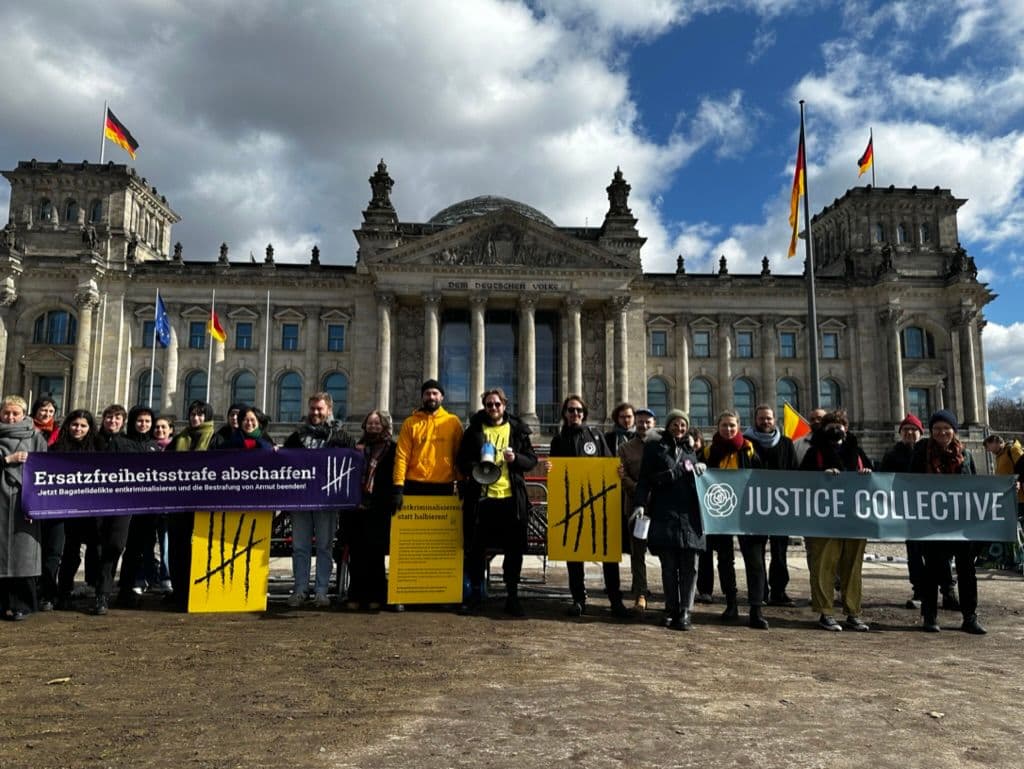
Jailing people for unpaid fines is about more than punishing poverty
Carmen Grimm, Bündnis zur Abschaffung der Ersatzfreiheitsstrafe
In Germany, people are incarcerated every day because they cannot pay a fine. Critics of this practice known as “Ersatzfreiheitsstrafe” are in agreement that a person’s economic status should not determine the severity of their sentence. The Coalition for the Abolition of Debtor’s Prisons agrees with this view – and urges critics to take a broader view attentive to the links between poverty and racism.