Case 12
| Case Number | 12 |
| Charge | Fare Evasion |
| Defense Attorney Present | No |
| Interpreter Present | No |
| Racialized Person | No |
| Outcome | Fine |
A man is sentenced to a €1,800 fine for multiple counts of fare evasion. He has no lawyer and seems to fear that he will be sent to prison after the trial.
Each year in Germany, between 8000 and 9000 people are sent to prison for riding public transport without a ticket. This is because many cannot afford to buy a ticket in the first place, receive a civil fine from the transit authority which they cannot afford, and are then charged with a criminal offense, often resulting in high fines, as in this case. People who are unable to pay for a criminal fine are sent to prison with a so-called Ersatzfreiheitsstrafe (EFS).
In this case, it is unclear whether the defendant knows that even though he is sentenced to a fine, he could nevertheless end up in prison because of EFS. The fine is more than three times the regular rate of social benefits, and his previous convictions for fare evasion suggest that he has had difficulties affording a monthly ticket in the past (though he had one at the time of the sentencing). Even at €9, the “social ticket” for social benefit recipients is not affordable for everyone, though the judge seems to assume this. The very high fine to which the man is sentenced effectively punishes poverty and will further increase his economic precarity.
A man enters the courtroom in jeans and a light jacket. He seems unsure of himself and at times during the trial it is unclear whether he can follow the proceedings. He states that he has applied for early retirement due to an impairment, but currently receives Bürgergeld. He has no lawyer and sits isolated in the courtroom with his head bowed forward.
He is accused of riding public transport without a ticket a total of six times over a period of just over a year. During the hearing of evidence, he says that he has nothing to say, he simply forgot his ticket. The judge asks if he now has a monthly pass, which the defendant confirms, showing it to the judge and prosecutor. After briefly discussing the man’s personal information, the court turns to his previous convictions: There have been “quite a few” since 2003, the judge remarks, and only reads out the most recent ones: one sentence for fare evasion eight years ago, and another one four years ago.
In his plea, the prosecutor considers the man’s statement and the fact that he now has a monthly ticket to speak in favor of the defendant, while the previous convictions speak against him. He demands a fine of 120 days at €15. Since there is no lawyer to plead for the defendant, the judge merely asks him for his last words. He has nothing to say and then there is a break. After a while, the defendant asks, seemingly anxious: “But I can go home afterwards?” The judge replies with a smile: “Yes, you can go home with your monthly ticket.” She hands down a sentence in line with the prosecutor’s plea, at a total of €1,800, explaining her reasoning: “It’s great that you now have a monthly pass. Please keep it that way. You can manage the €9, even from your early retirement pension.” She concludes the hearing, saying: “Thank you, that’s it.” The man stands up, turns around and leaves the room. He smiles, seemingly relieved.
Cases from our archive
Case 39
A young woman experiencing homelessness is sentenced to 90 days of fine payment for supplying drugs. The conviction will not appear on her Certificate of Good Conduct (Führungszeugnis), which was important to her, but the court punishes her with a high fine even as it acknowledges she was supplying drugs because of her poverty.
Case 38
This case concerned a person currently serving a prison sentence being found with a small quantity of cannabis, an amount that would usually not be prosecuted in Berlin. The person is brought to the court from the prison to stand trial and is sentenced to a €30 fine.
Case 37
A white defendant with access to private counsel is sentenced to a fine for possession of 15 small bags of cannabis, with a total amount of cannabis above the legal threshold for a “low quantity” (nicht geringe Menge). The court accepts her account that the cannabis was for personal use, and justifies the relatively mild sentence with a favorable assessment of the defendant living a “normal bourgeois life”.
Case 36
In a case heard shortly before the 2024 law change that legalized certain forms of cultivation, possession, and acquisition of cannabis in Germany, a young man is accused of selling cannabis via car delivery. Despite the relatively low quantity of cannabis found and the person having childcare responsibilities and financial difficulties, the prosecution recommends a sentence of over a year in prison. In the end, the judge imposes a long probation sentence, severe in light of the impending opening of the cannabis market.
Perspectives

Structures of Anti-Roma Racism: An interview with Amaro Foro’s Valerie Laukat
Justice Collective
Courtwatching often reveals the deep-rooted structures of anti-Roma racism in German public institutions and society. In this interview, we find out more about how anti-Roma racism is embedded in broader structures of exploitation and exclusion – and how to work towards transformative change.
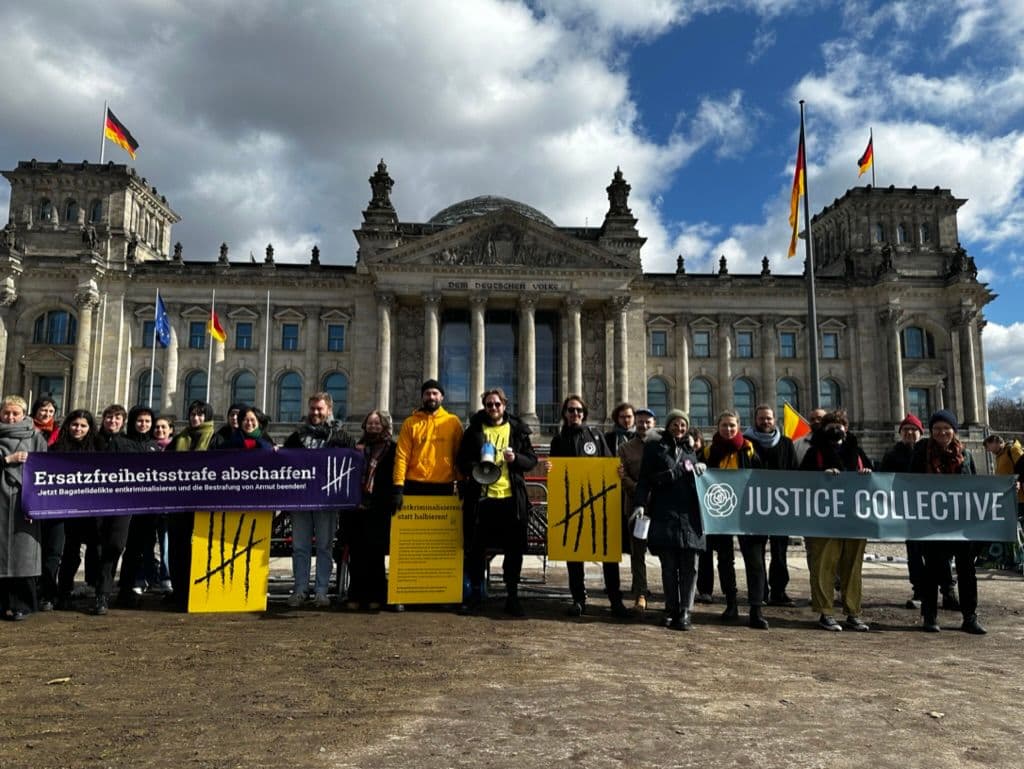
Jailing people for unpaid fines is about more than punishing poverty
Carmen Grimm, Bündnis zur Abschaffung der Ersatzfreiheitsstrafe
In Germany, people are incarcerated every day because they cannot pay a fine. Critics of this practice known as “Ersatzfreiheitsstrafe” are in agreement that a person’s economic status should not determine the severity of their sentence. The Coalition for the Abolition of Debtor’s Prisons agrees with this view – and urges critics to take a broader view attentive to the links between poverty and racism.