Case 9
| Case Number | 9 |
| Charge | Other Offenses |
| Defense Attorney Present | No |
| Interpreter Present | No |
| Racialized Person | Yes |
| Outcome | Fine |
A man is fined for insulting a job center employee over the phone. Throughout the trial, the court is impatient with the defendant, urging him to be compliant with the job center and refusing to see why someone relying on social benefits might get frustrated with this institution.
The person accused of insult in this case says that he receives different amounts from the job center each month, at less than the standard amount. This indicates that he is likely struggling with the surveillance and sanctioning tactics of the job center, which are designed to keep government spending to a minimum and pressure people into taking up employment as quickly as possible, even under exploitative conditions. In recent years, racist narratives in politics and the media have stoked moral panics around migrants supposedly coming to Germany to commit large-scale welfare fraud.1 The person accused of insult in this case is a racialized German citizen, suggesting that increased job center scrutiny extends beyond recently migrantized populations as well.
While it should come as no surprise that someone might voice their frustration when faced with scrutiny and sanctions over the income that sustains their livelihood, the court shows no understanding whatsoever. On the contrary, the court in this case acts as an extension of the punitive job center system, serving to further discipline people seeking benefits.
The person receives a very high fine (over four months of income) without the assistance of an attorney. Indeed, much of the escalating dynamic in the courtroom is due to the judge’s negative assessment of the person’s demeanor and racialized interpretation of his attempts to defend himself. Due to racist stereotypes, people from racialized groups are often accused of acting emotionally or irrationally.
Here, we see how racial capitalism works in practice, entrenching racist structures of social hierarchy within an exploitative system of class relations and neoliberal minimizing of the welfare state.
To start the trial, the judge asks the accused if he has any other citizenship, which he does not. He is unemployed and receives Bürgergeld, which he says is less than the standard rate and varies in amount each month.
The man is accused of calling a job center staff member names after receiving negative news about his social benefits. When asked for a comment, the accused tries to explain himself by saying that he did not directly call the employee names but rather had rhetorically questioned whether the employee was making any sense, which was taken as an insult.
He is visibly upset by the allegations and the questioning and tries to communicate his perspective. He and the judge go back and forth, at times causing confusion over who should be speaking when, to the frustration of the judge (“Sie sind nicht dran!”). At one point, the judge asks:
It is unclear whether the judge is referring to the allegations of the case or the person’s attempts to explain their side of the story. The court takes the man’s statements as a confession and dismisses the witness, the job center employee. The judge accepts the prosecution’s plea for a total fine of over €1,500, adding, “You do still want benefits from the job center, right? How can you then treat the employees like that?”
The judge and prosecutor laugh as the defendant leaves the room.
Citations
- 1
Mitali Nagrecha and Anthony Obst, “‘Clankriminalität’, ‘Sozialbetrug’ und die Massenkriminalisierung von Sozialleistungsberechtigten” in Mohammed Ali Chahrour, Levi Sauer, Lina Schmid, Jorinde Schulz, Michèle Winkler (eds), Generalverdacht: Wie mit dem Mythos Clankriminalität Politik gemacht wird (Nautilus 2023).
Cases from our archive
Case 39
A young woman experiencing homelessness is sentenced to 90 days of fine payment for supplying drugs. The conviction will not appear on her Certificate of Good Conduct (Führungszeugnis), which was important to her, but the court punishes her with a high fine even as it acknowledges she was supplying drugs because of her poverty.
Case 38
This case concerned a person currently serving a prison sentence being found with a small quantity of cannabis, an amount that would usually not be prosecuted in Berlin. The person is brought to the court from the prison to stand trial and is sentenced to a €30 fine.
Case 37
A white defendant with access to private counsel is sentenced to a fine for possession of 15 small bags of cannabis, with a total amount of cannabis above the legal threshold for a “low quantity” (nicht geringe Menge). The court accepts her account that the cannabis was for personal use, and justifies the relatively mild sentence with a favorable assessment of the defendant living a “normal bourgeois life”.
Case 36
In a case heard shortly before the 2024 law change that legalized certain forms of cultivation, possession, and acquisition of cannabis in Germany, a young man is accused of selling cannabis via car delivery. Despite the relatively low quantity of cannabis found and the person having childcare responsibilities and financial difficulties, the prosecution recommends a sentence of over a year in prison. In the end, the judge imposes a long probation sentence, severe in light of the impending opening of the cannabis market.
Perspectives

Structures of Anti-Roma Racism: An interview with Amaro Foro’s Valerie Laukat
Justice Collective
Courtwatching often reveals the deep-rooted structures of anti-Roma racism in German public institutions and society. In this interview, we find out more about how anti-Roma racism is embedded in broader structures of exploitation and exclusion – and how to work towards transformative change.
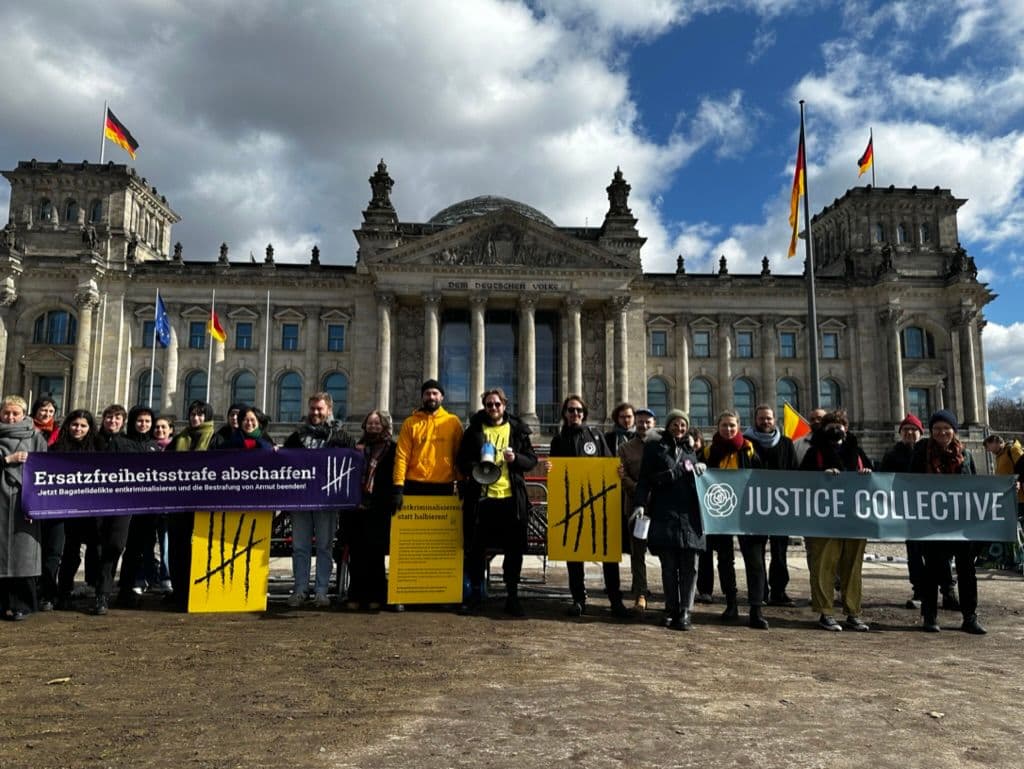
Jailing people for unpaid fines is about more than punishing poverty
Carmen Grimm, Bündnis zur Abschaffung der Ersatzfreiheitsstrafe
In Germany, people are incarcerated every day because they cannot pay a fine. Critics of this practice known as “Ersatzfreiheitsstrafe” are in agreement that a person’s economic status should not determine the severity of their sentence. The Coalition for the Abolition of Debtor’s Prisons agrees with this view – and urges critics to take a broader view attentive to the links between poverty and racism.