Case 6
| Case Number | 6 |
| Charge | Theft |
| Defense Attorney Present | Yes |
| Interpreter Present | Yes |
| Racialized Person | Yes |
| Outcome | Probation |
A young woman is sentenced to nine months prison on probation for multiple counts of theft. Her disinterested lawyer barely makes a case for her and does not shed light on the details of her precarious employment status, which provides a crucial backdrop in this case, but in the end does not move the court anyway.
Despite our courtwatchers overhearing conversations between the judge and defense attorney before the trial, some things remain unclear, including whether or how well the woman being tried could understand the interpreter (who came from a different country and did not say much) and the details of her employment situation. We therefore do not know whether she has any income at all at the time of her trial. Her lawyer appeared largely passive and did not seem to bring out arguments or raise issues.
To comprehend the structural circumstances of this case, we need to take some background information into account. The accused woman is from a country recently designated as “safe” by Germany in asylum procedures—a designation that was widely criticized. This means that if she is applying for asylum (which is unclear in this case), she will have most likely lost her permission to work. Either this is the case, or she continues to be employed as a seasonal worker in a precarious sector that is notorious for recruiting underpaid labor from outside Germany. In either scenario, the woman’s life in Germany is shaped by racist structures—be they of overexploitation or of exclusion—, which make it almost impossible for her to secure her livelihood legally.
In court, discussions of people’s circumstances that may shed light on structural inequities are always fleeting. If the court dug deeper, it may have to confront the futility and injustice of the punishment. In this case, the court learns about the woman’s precarious employment situation, which provides the backdrop for the multiple counts of theft that she is charged with. Yet, this does not move the court’s assessment in any meaningful way. In the end, the judge sentences her harshly anyway.
The court observation began with the pretrial conferencing, during which the judge and defense attorney, joking with each other, go through the files together to agree to hear all the charges that day. Before the woman walks in, the judge also confers with the attorney about his client’s financial situation, who says the defendant is not working anymore.
Then, a young woman enters, who is the defendant in this case. She shares that she is currently working a minimum wage job and that she is sorry for the offenses. Her attorney does not offer much in her defense and agrees with the prosecutor’s suggested sentence of three years of probation, convertible to nine months in prison if she violates probation. The judge adopts this high sentence and briefly justifies it by saying that despite her confession being a mitigating factor, the value of the goods taken was high.
Cases from our archive
Case 39
A young woman experiencing homelessness is sentenced to 90 days of fine payment for supplying drugs. The conviction will not appear on her Certificate of Good Conduct (Führungszeugnis), which was important to her, but the court punishes her with a high fine even as it acknowledges she was supplying drugs because of her poverty.
Case 38
This case concerned a person currently serving a prison sentence being found with a small quantity of cannabis, an amount that would usually not be prosecuted in Berlin. The person is brought to the court from the prison to stand trial and is sentenced to a €30 fine.
Case 37
A white defendant with access to private counsel is sentenced to a fine for possession of 15 small bags of cannabis, with a total amount of cannabis above the legal threshold for a “low quantity” (nicht geringe Menge). The court accepts her account that the cannabis was for personal use, and justifies the relatively mild sentence with a favorable assessment of the defendant living a “normal bourgeois life”.
Case 36
In a case heard shortly before the 2024 law change that legalized certain forms of cultivation, possession, and acquisition of cannabis in Germany, a young man is accused of selling cannabis via car delivery. Despite the relatively low quantity of cannabis found and the person having childcare responsibilities and financial difficulties, the prosecution recommends a sentence of over a year in prison. In the end, the judge imposes a long probation sentence, severe in light of the impending opening of the cannabis market.
Perspectives

Structures of Anti-Roma Racism: An interview with Amaro Foro’s Valerie Laukat
Justice Collective
Courtwatching often reveals the deep-rooted structures of anti-Roma racism in German public institutions and society. In this interview, we find out more about how anti-Roma racism is embedded in broader structures of exploitation and exclusion – and how to work towards transformative change.
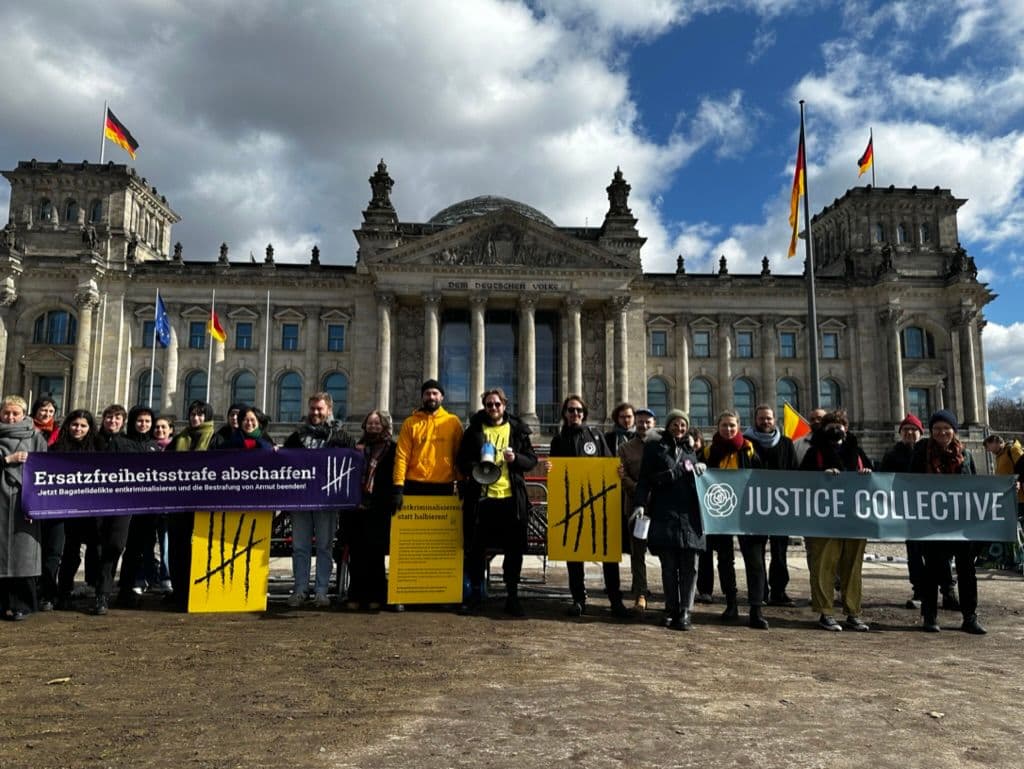
Jailing people for unpaid fines is about more than punishing poverty
Carmen Grimm, Bündnis zur Abschaffung der Ersatzfreiheitsstrafe
In Germany, people are incarcerated every day because they cannot pay a fine. Critics of this practice known as “Ersatzfreiheitsstrafe” are in agreement that a person’s economic status should not determine the severity of their sentence. The Coalition for the Abolition of Debtor’s Prisons agrees with this view – and urges critics to take a broader view attentive to the links between poverty and racism.