Case 4
| Case Number | 4 |
| Charge | Fare Evasion |
| Defense Attorney Present | Yes |
| Interpreter Present | Yes |
| Racialized Person | Yes |
| Outcome | Probation |
A young woman is sentenced to three years on probation for three counts of fare evasion. If she is caught without a train ticket again she faces multiple months in prison and likely loses her precarious job.
The court drew on a number of assumptions in this case to determine the question of intent, including the assumption that the woman was engaged in fraud because her client number was not on her monthly ticket, and the assumption she intended not to pay because she had been sentenced for the same offense before. These assumptions reflect prejudice on the part of the judge. During the trial, she acts as an extended arm of the job center (“Why aren’t you working more?”) as well as of the immigration authorities (“Why don’t you speak German?”), and her character judgments contribute to her harsh sentence, while the accused woman’s structural socio-economic situation is barely considered.
To our courtwatchers, the trial felt like a theatrical staging of judgment, especially as the judge and prosecutor gathered around the woman’s ticket, inspecting it, turning it over, and ultimately conjecturing that she may be committing fraud. Their conjecture also implied a kind of blanket suspicion of other, undefined “people” supposedly trying to cheat the system. By doing so, they tap into a racialized discourse around fraud, as politicians and media outlets in Germany stoke moral panics around migrantized people supposedly illegitimately laying claim to resources.
The person being tried is a young woman who works in a precarious job. The judge quizzes why she does not work more hours. She has children and explains that because of this she can only work limited hours. The year prior (possibly during the period of the alleged offenses) she was unemployed for multiple months.
She is accused of three counts of riding public transportation without a ticket. Her attorney explains that she had a monthly ticket but could not produce it when controlled on these occasions. Therefore she did not intend to commit an offense.
The judge and prosecutor spend time inspecting the monthly ticket the woman brought as evidence. They speculate that because her client number was not on the ticket she was cheating the system in some way. (“This is how people do it!”, says the prosecutor). The judge says that people do not throw away their transportation tickets and questions why the woman did not bring the other tickets to trial as well. The woman asks for forgiveness.
Her attorney defends the woman and notes that her client does not speak German (which is why she has trouble understanding as is also with an interpreter at trial). The judge asks why that is the case given the woman has been in Germany for many years and says it is clear to her the defendant intended not to pay for the train.
The prosecutor mentions the woman’s past offenses of riding the train without a ticket and argues that therefore there was intent in this case. The prosecutor notes the woman has a job and children and recommends a sentence of probation. Her attorney argues that she is “well integrated” (“in comparison to my other clients”) and that the court does not have evidence of intent not to pay. The judge sentences the woman to multiple months in prison, to be served as three years on probation. She explains the sentence as appropriate because the woman has a “positive social prognosis” since she works—though she works little, according to the judge, and will have to work more when her children are older.
Cases from our archive
Case 39
A young woman experiencing homelessness is sentenced to 90 days of fine payment for supplying drugs. The conviction will not appear on her Certificate of Good Conduct (Führungszeugnis), which was important to her, but the court punishes her with a high fine even as it acknowledges she was supplying drugs because of her poverty.
Case 38
This case concerned a person currently serving a prison sentence being found with a small quantity of cannabis, an amount that would usually not be prosecuted in Berlin. The person is brought to the court from the prison to stand trial and is sentenced to a €30 fine.
Case 37
A white defendant with access to private counsel is sentenced to a fine for possession of 15 small bags of cannabis, with a total amount of cannabis above the legal threshold for a “low quantity” (nicht geringe Menge). The court accepts her account that the cannabis was for personal use, and justifies the relatively mild sentence with a favorable assessment of the defendant living a “normal bourgeois life”.
Case 36
In a case heard shortly before the 2024 law change that legalized certain forms of cultivation, possession, and acquisition of cannabis in Germany, a young man is accused of selling cannabis via car delivery. Despite the relatively low quantity of cannabis found and the person having childcare responsibilities and financial difficulties, the prosecution recommends a sentence of over a year in prison. In the end, the judge imposes a long probation sentence, severe in light of the impending opening of the cannabis market.
Perspectives

Structures of Anti-Roma Racism: An interview with Amaro Foro’s Valerie Laukat
Justice Collective
Courtwatching often reveals the deep-rooted structures of anti-Roma racism in German public institutions and society. In this interview, we find out more about how anti-Roma racism is embedded in broader structures of exploitation and exclusion – and how to work towards transformative change.
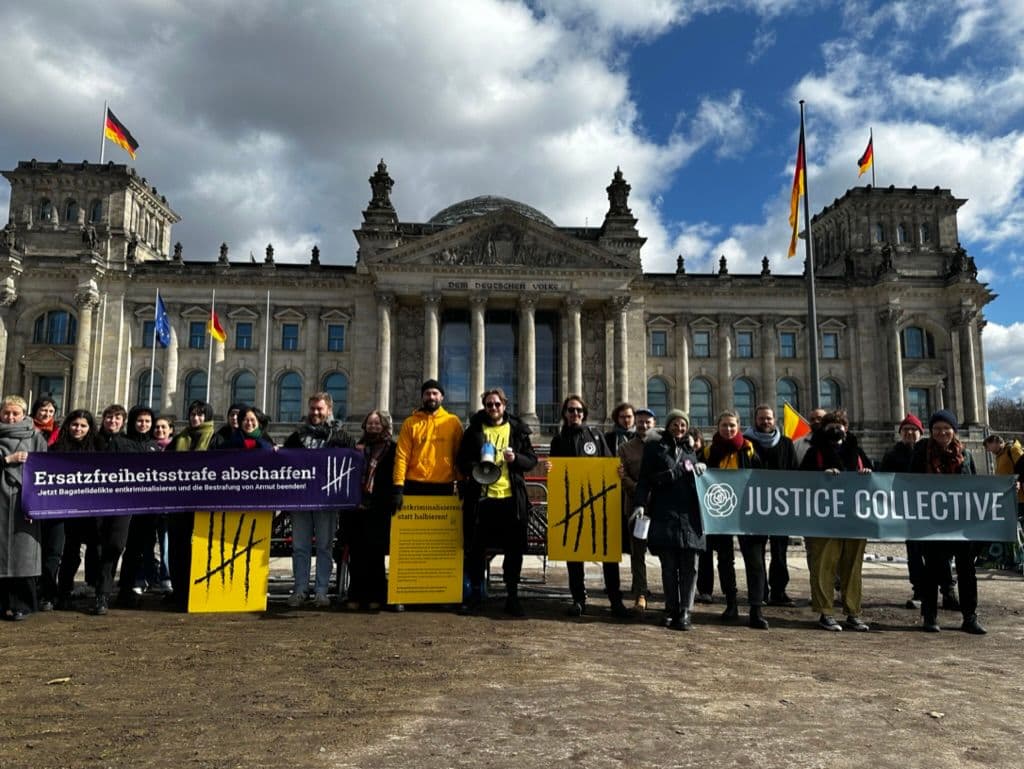
Jailing people for unpaid fines is about more than punishing poverty
Carmen Grimm, Bündnis zur Abschaffung der Ersatzfreiheitsstrafe
In Germany, people are incarcerated every day because they cannot pay a fine. Critics of this practice known as “Ersatzfreiheitsstrafe” are in agreement that a person’s economic status should not determine the severity of their sentence. The Coalition for the Abolition of Debtor’s Prisons agrees with this view – and urges critics to take a broader view attentive to the links between poverty and racism.