Case 20
| Case Number | 20 |
| Charge | Theft |
| Defense Attorney Present | No |
| Interpreter Present | Yes |
| Racialized Person | Yes |
| Outcome | Fine |
Three young defendants are summoned to fast-track proceedings (Schnellgericht) for a low-level theft case. Because the court has not lined up an interpreter for one of them, he will not be heard and instead will be sentenced with summary proceedings (Strafbefehl), meaning he will receive his sentence in the mail. After a quick hearing, the other two are each punished with €600 fines.
As with many cases we observe, the judge takes procedural shortcuts that have significant negative impacts. Though he appeared in court, the third defendant (D3) is not provided an opportunity to testify in a full trial, because the court failed to line up the correct translator and now refuses to do so. The judge also assesses that both of the others should pay €15/day of punishment – even though, since they are asylum seekers, they likely have very limited, if any, cash benefits. The court should have asked additional questions about their finances and set lower fines but did not. These procedural shortcuts show how supposedly “neutral” policies and practices facilitate the court acting as part of the border regime: The judge sentences harshly and expresses hope that all three young men will leave the country.
The case begins with back and forth over interpretation. One interpreter is present for all three defendants, who are accused of participating together in low-level theft of clothing valued at approximately €150. However, only two of the three young men speak the same language and while the interpreter is able to communicate with the third defendant (D3) to some extent, he is not certified to handle interpretation into this language as well..
The judge, prosecutor, and interpreter deliberate about what to do and decide that rather than postpone the case and get an additional interpreter, they will sentence D3 via summary proceedings. D3 is able to communicate to the court that he plans to leave Germany and return to his home country within a few weeks and the judge expresses hope that the summary proceedings order reaches him by mail before his departure.
Once this sentence has been decided, the case moves on to the other two defendants. Both are young and have been in Germany for a short time and do not have work permits. They confess to the allegations of theft, and after a brief exchange about what items exactly D1 was responsible for taking, the judge ends the questioning. Both are sentenced to fines of 40 days at €15/day for a total fine of €600 each, which the judge explains as “sufficient” because they might leave the country. It is unclear why the judge assumes this.
Cases from our archive
Case 39
A young woman experiencing homelessness is sentenced to 90 days of fine payment for supplying drugs. The conviction will not appear on her Certificate of Good Conduct (Führungszeugnis), which was important to her, but the court punishes her with a high fine even as it acknowledges she was supplying drugs because of her poverty.
Case 38
This case concerned a person currently serving a prison sentence being found with a small quantity of cannabis, an amount that would usually not be prosecuted in Berlin. The person is brought to the court from the prison to stand trial and is sentenced to a €30 fine.
Case 37
A white defendant with access to private counsel is sentenced to a fine for possession of 15 small bags of cannabis, with a total amount of cannabis above the legal threshold for a “low quantity” (nicht geringe Menge). The court accepts her account that the cannabis was for personal use, and justifies the relatively mild sentence with a favorable assessment of the defendant living a “normal bourgeois life”.
Case 36
In a case heard shortly before the 2024 law change that legalized certain forms of cultivation, possession, and acquisition of cannabis in Germany, a young man is accused of selling cannabis via car delivery. Despite the relatively low quantity of cannabis found and the person having childcare responsibilities and financial difficulties, the prosecution recommends a sentence of over a year in prison. In the end, the judge imposes a long probation sentence, severe in light of the impending opening of the cannabis market.
Perspectives

Structures of Anti-Roma Racism: An interview with Amaro Foro’s Valerie Laukat
Justice Collective
Courtwatching often reveals the deep-rooted structures of anti-Roma racism in German public institutions and society. In this interview, we find out more about how anti-Roma racism is embedded in broader structures of exploitation and exclusion – and how to work towards transformative change.

Criminalized: The Anti-Migration Debate Fuels and Legitimizes Systemic Racism
Anthony Obst, Justice Collective
Fueled by media coverage of isolated violent incidents, a troubling consensus has emerged that presents increasingly severe law-and-order measures as the only solution to perceived insecurity supposedly caused by immigration. This obscures the violent realities of racist criminalization.
Refugees in Germany: The omnipresent border regime
Britta Rabe, Grundrechtekomitee
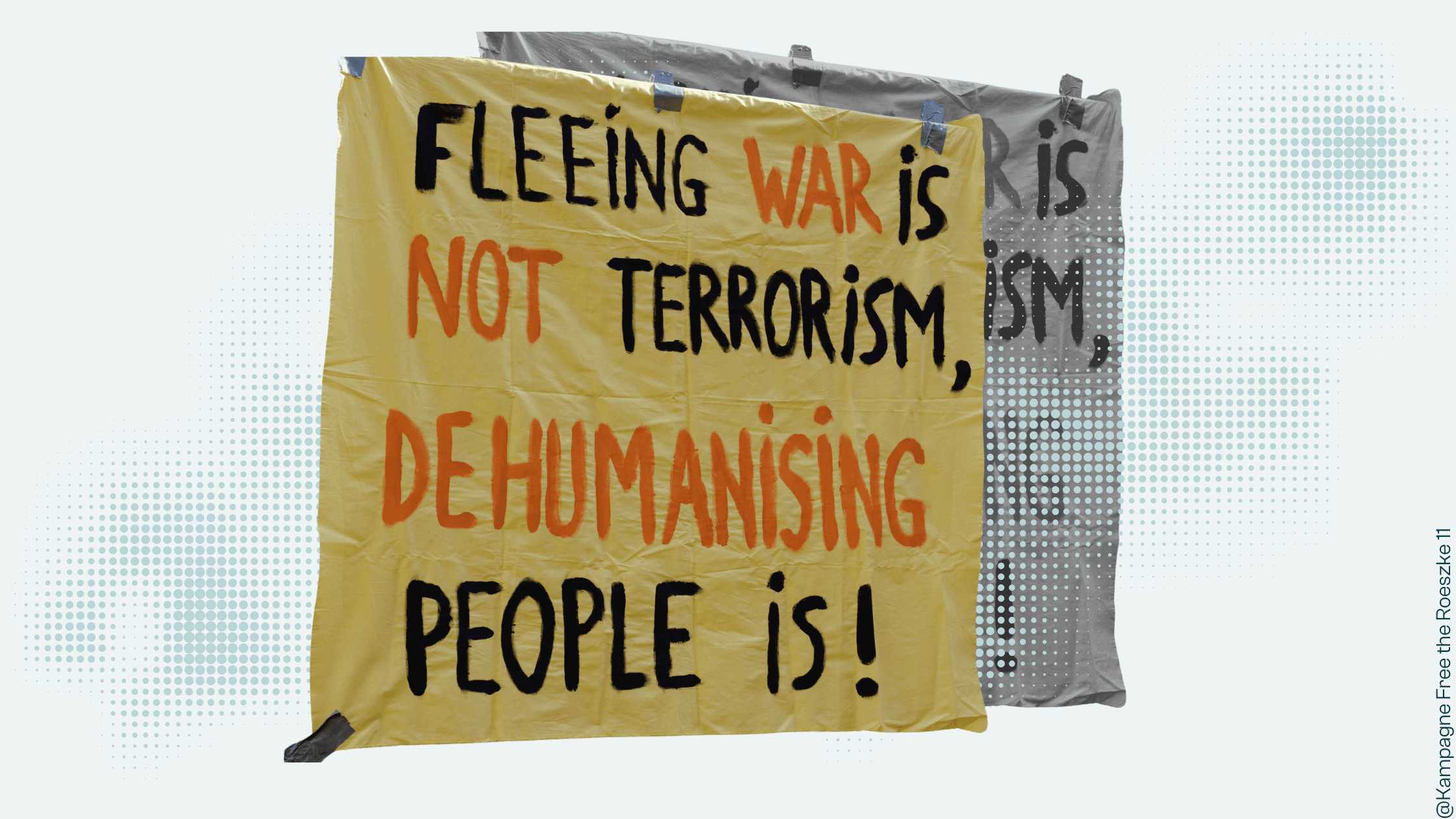
Even after surviving perilous journeys to reach the EU – which can include pushbacks, beatings, and torture – refugees face an exclusionary system within Fortress Europe that makes their arrival difficult or even impossible. The EU border regime extends all the way into Germany, permeating society invisibly yet tangibly for those who are excluded.