Case 2
| Case Number | 2 |
| Charge | Theft |
| Defense Attorney Present | Yes |
| Interpreter Present | No |
| Racialized Person | Yes |
| Outcome | Fine |
A young woman admits to having stolen a bag full of groceries and offers her apologies. Yet, the judge imposes a high fine, threatening the woman with prison in case she is convicted of another offense.
The “integration” discourse, which the defense strategy draws on in this case, makes structural conditions appear as though they could be easily overcome by individuals’ personal choices. This liberal “common sense” is reflected in the judge’s words and actions as well, making it seem as though the fact of the woman’s criminalization was a matter of attitude and character. In part because of this discourse, migrantized people in Germany are under constant pressure to prove that they are “worthy” – by showing, for instance, that they want to work and learn the language, otherwise the state will be harsh with them. In this case, the judge adds to this their specific expectations for migrantized mothers, who are all the more harshly scrutinized in cases we have seen, openly reprimanded for being “bad mothers”, even when their criminalization is embedded in structural conditions.
Even though the woman struggles to make ends meet, the judge sentences her to a high fine, which is only going to make things more difficult.
The defendant is a young mother whose sole income source is the job center. She has a lawyer who appears to have prepared a defense strategy for her: The lawyer talks about the difficult circumstances of her client, including war in her home country and difficulties trying to – as she puts it – “integrate” in Germany. She mentions that her client has been doing an integration course and that she already paid a so-called “Fangprämie” fine at the store where she was caught stealing. Then the woman speaks for herself.
The judge responds with an implied judgment regarding the woman’s abilities as a mother.
The judge then goes on to read the defendant’s record, which lists three prior convictions for theft. The lawyer notes that all of these convictions were by penal order (“Strafbefehl”), suggesting that her client might have had difficulties understanding their content and their significance as criminal convictions.
In her final statement, the woman reasserts that she is trying to learn German and wants to find work. The judge notes that the woman’s promise is now in writing and that, therefore, she will be sent to prison for the next offense. Her reasoning lays out that while the woman’s prior convictions spoke against her, the fact that she only stole groceries and not “luxury items” as well as her willingness to “integrate” and to work spoke for her.
Cases from our archive
Case 39
A young woman experiencing homelessness is sentenced to 90 days of fine payment for supplying drugs. The conviction will not appear on her Certificate of Good Conduct (Führungszeugnis), which was important to her, but the court punishes her with a high fine even as it acknowledges she was supplying drugs because of her poverty.
Case 38
This case concerned a person currently serving a prison sentence being found with a small quantity of cannabis, an amount that would usually not be prosecuted in Berlin. The person is brought to the court from the prison to stand trial and is sentenced to a €30 fine.
Case 37
A white defendant with access to private counsel is sentenced to a fine for possession of 15 small bags of cannabis, with a total amount of cannabis above the legal threshold for a “low quantity” (nicht geringe Menge). The court accepts her account that the cannabis was for personal use, and justifies the relatively mild sentence with a favorable assessment of the defendant living a “normal bourgeois life”.
Case 36
In a case heard shortly before the 2024 law change that legalized certain forms of cultivation, possession, and acquisition of cannabis in Germany, a young man is accused of selling cannabis via car delivery. Despite the relatively low quantity of cannabis found and the person having childcare responsibilities and financial difficulties, the prosecution recommends a sentence of over a year in prison. In the end, the judge imposes a long probation sentence, severe in light of the impending opening of the cannabis market.
Perspectives

Structures of Anti-Roma Racism: An interview with Amaro Foro’s Valerie Laukat
Justice Collective
Courtwatching often reveals the deep-rooted structures of anti-Roma racism in German public institutions and society. In this interview, we find out more about how anti-Roma racism is embedded in broader structures of exploitation and exclusion – and how to work towards transformative change.
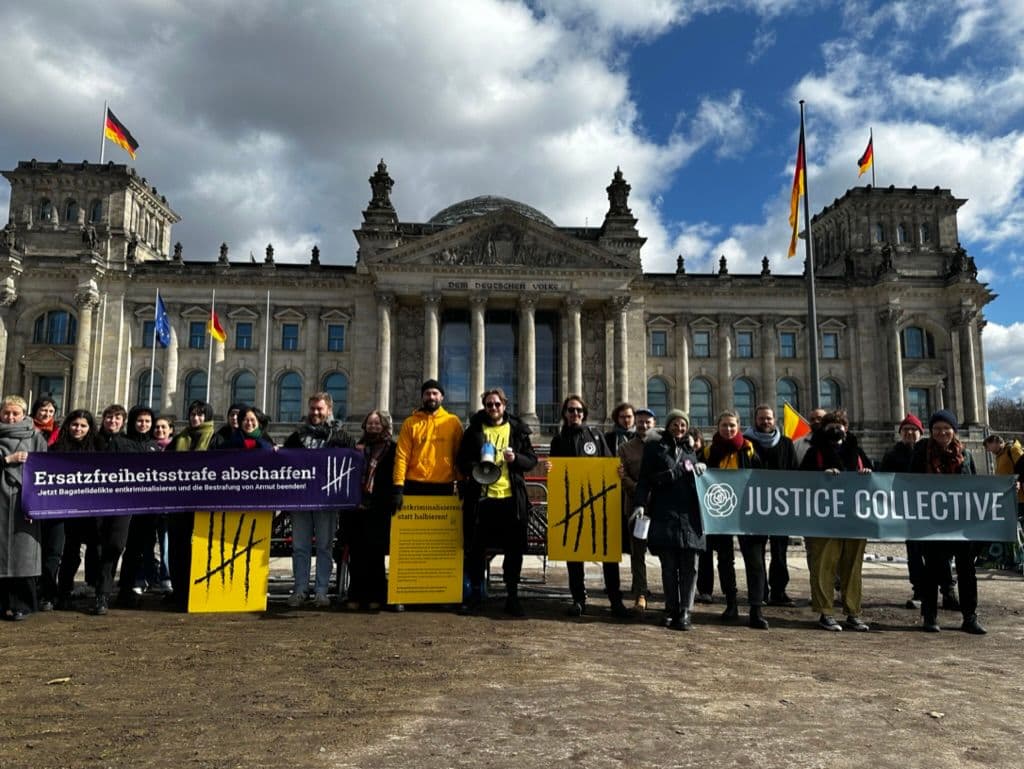
Jailing people for unpaid fines is about more than punishing poverty
Carmen Grimm, Bündnis zur Abschaffung der Ersatzfreiheitsstrafe
In Germany, people are incarcerated every day because they cannot pay a fine. Critics of this practice known as “Ersatzfreiheitsstrafe” are in agreement that a person’s economic status should not determine the severity of their sentence. The Coalition for the Abolition of Debtor’s Prisons agrees with this view – and urges critics to take a broader view attentive to the links between poverty and racism.