Case 14
| Case Number | 14 |
| Charge | Theft |
| Defense Attorney Present | Yes |
| Interpreter Present | Yes |
| Racialized Person | Yes |
| Outcome | Prison |
A young racialized man has spent over a month in pretrial detention. He is sentenced to a year and a half in prison, without probation, for six counts of theft. Playing a role in the proceedings was that he had been repeatedly stopped by police at a so-called “crime hotspot” (kriminalitätbelastete Orte). While some resulting cases against him were dropped, they added to the court’s perception of the defendant as having “criminal energy”.
The judge holds against the defendant in sentencing that he has been controlled before by the police in a “crime hotspot” (“kriminalitätsbelastete Orte”). These are areas that the police have classified as particularly “dangerous”, therefore allowing them to carry out random checks with the possibility of further follow-up measures, which is otherwise only legal if there is “initial suspicion”. In many cases, these are areas with a large immigrant population. Random ID checks enable racial profiling as a common police practice, which is usually very humiliating for those affected, as it takes place in public and thus also reproduces racist images. This means the man in this case is sentenced more harshly because he was stopped in an area that provides legal cover for racial profiling. The judge’s approach goes beyond the usual problematic practice of sentencing people more harshly based on past offenses: In this case, although the charges against the man resulting from these stops were dropped, they are still weighed against him. Racial profiling thus creates a self-reinforcing cycle as merely being controlled marks people as “criminal”, which then leads to harsher penalties.
Aggravating the penalty against the person was also that the court found him to be engaged in “professional” or “commercial” (gewerbsmäßig) theft because he is accused of committing multiple offenses in a short period. According to the law, he would have to be punished with prison time of three months to up to 10 years, if each of the thefts resulted in damages of approximately more than 50 EUR, § 243 (1) (2) StGB. This law (§ 243 (1) (2) StGB) has been criticized by experts as a poverty penalty and discrimination against people with substance use issues. People who steal out of necessity, and therefore regularly, are punished more harshly through this sentencing enhancement. However, addiction should be considered a mitigating factor in sentencing, this is especially the case if the person stole solely to fund their addiction, and not for basic needs like rent or clothing. That the accused man in this case says he stole because of a substance use issue is given short shrift in the judge’s assessment.
Proceedings start with the defendant being brought from pretrial detention, where he has been for over a month. It is mentioned that he does not have a place of residence in Germany, which is likely why he is being jailed pretrial for six counts of so-called “professional” or “commercial” theft.
After reading out the details of the alleged incidents, we hear from the defense attorney, who says that his client admits to the allegations. His client did not have income at the time of the incidents and was unable to find work. He also mentions his client’s use of drugs (a mitigating factor), but does not elaborate until prompted by the judge. The defendant explains that he was consuming drugs regularly and stole to sustain his drug addiction.
The judge raises that according to her information, the defendant was known to the police, who had stopped him multiple times at a “crime hotspot”. At one point, drugs were allegedly found on the defendant, but the prosecution dropped all cases from these stops related to drug supply offenses.
The prosecution requests a sentence of 1 year and 6 months in prison, without probation. In part, she justifies this sentence by saying that because the offenses occurred close in time, there was premeditation and a “business-like approach”. The defendant's attorney reiterates the prosecution’s points. On the side of the defendant, he says that his client struggled with drug addiction and could not find a job. He suggests an eight-month prison sentence, on probation.
Ultimately the defendant is sentenced to a year and a half in prison. In explaining her decision, the judge says she considered that the defendant spent more than a month in pretrial detention which, she says she knows “is not super easy for a non-native German speaker.” She says she believes that drug use played a role in the offenses but also that the defendant had a “business-like” approach. She also raises the police controls at the hotspot, saying that the frequent police controls seem to have made no “lasting impression” on him. Given all that, she says that she cannot see how someone like him (she emphasizes this) could get on a positive track without therapy and rehabilitation.
Cases from our archive
Case 39
A young woman experiencing homelessness is sentenced to 90 days of fine payment for supplying drugs. The conviction will not appear on her Certificate of Good Conduct (Führungszeugnis), which was important to her, but the court punishes her with a high fine even as it acknowledges she was supplying drugs because of her poverty.
Case 38
This case concerned a person currently serving a prison sentence being found with a small quantity of cannabis, an amount that would usually not be prosecuted in Berlin. The person is brought to the court from the prison to stand trial and is sentenced to a €30 fine.
Case 37
A white defendant with access to private counsel is sentenced to a fine for possession of 15 small bags of cannabis, with a total amount of cannabis above the legal threshold for a “low quantity” (nicht geringe Menge). The court accepts her account that the cannabis was for personal use, and justifies the relatively mild sentence with a favorable assessment of the defendant living a “normal bourgeois life”.
Case 36
In a case heard shortly before the 2024 law change that legalized certain forms of cultivation, possession, and acquisition of cannabis in Germany, a young man is accused of selling cannabis via car delivery. Despite the relatively low quantity of cannabis found and the person having childcare responsibilities and financial difficulties, the prosecution recommends a sentence of over a year in prison. In the end, the judge imposes a long probation sentence, severe in light of the impending opening of the cannabis market.
Perspectives

Structures of Anti-Roma Racism: An interview with Amaro Foro’s Valerie Laukat
Justice Collective
Courtwatching often reveals the deep-rooted structures of anti-Roma racism in German public institutions and society. In this interview, we find out more about how anti-Roma racism is embedded in broader structures of exploitation and exclusion – and how to work towards transformative change.

Simsim Abdo from Kotti Cares on how the police targets migrantized communities in Berlin
Justice Collective
This interview provides on-the-ground insights on the day-to-day criminalization of migrant youths around Kottbusser Tor.
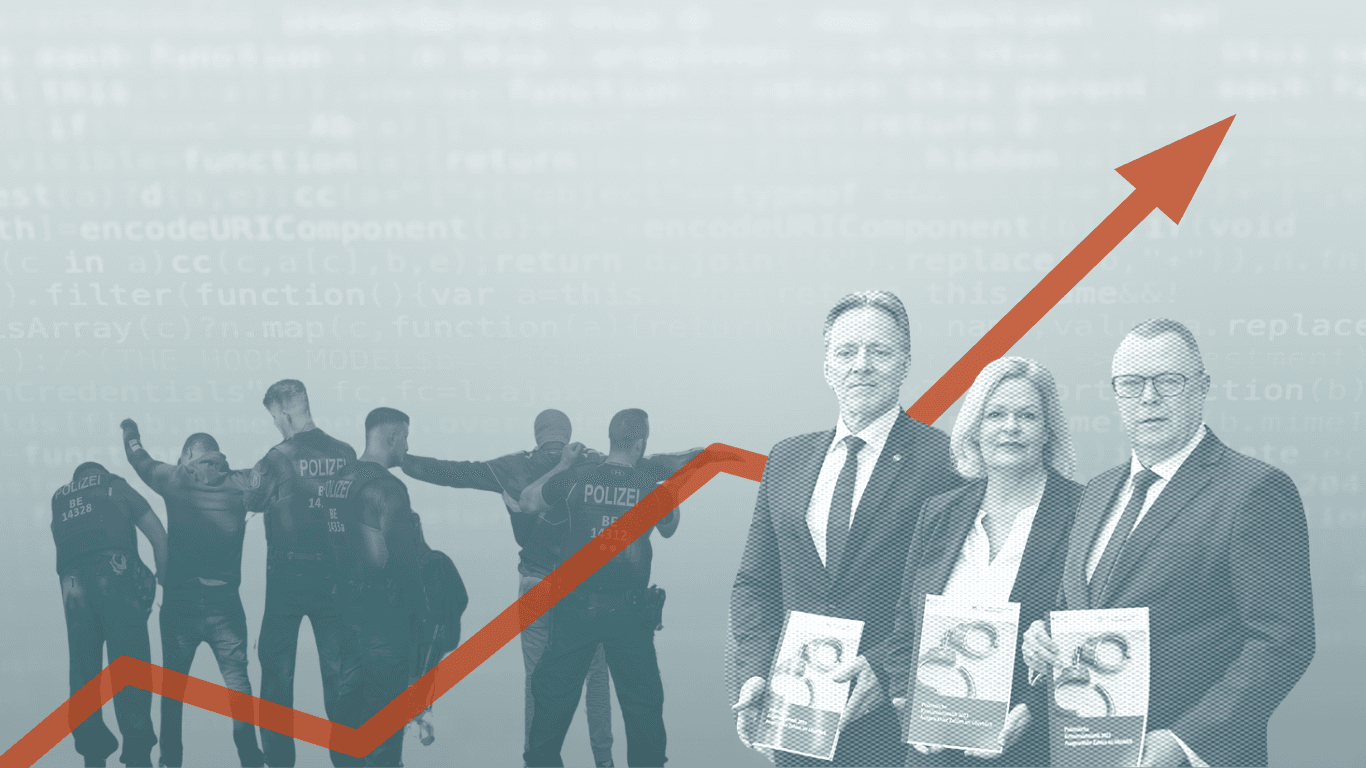
Die polizeiliche Kriminalstatistik ist als Instrument zur Bewertung der Sicherheitslage ungeeignet
Justice Collective, Grundrechtekomitee und 40 weitere
Wissenschaftler*innen und Mitglieder der Zivilgesellschaft warnen vor der politisierten Nutzung der polizeilichen Kriminalitätsstatistik, die jedes Jahr dafür genutzt wird, falsche Narrative über steigende Kriminalität und vermeintlich „kriminelle Migrant*innen“ zu verbreiten. Die Unterzeichnenden stellen das durch das BKA und die Medien gezeichnete statistische Bild entschieden in Frage und betonen, dass die PKS zur Polarisierung der Gesellschaft und Stigmatisierung bestimmter Bevölkerungsgruppen beiträgt.

Criminalized: The Anti-Migration Debate Fuels and Legitimizes Systemic Racism
Anthony Obst, Justice Collective
Fueled by media coverage of isolated violent incidents, a troubling consensus has emerged that presents increasingly severe law-and-order measures as the only solution to perceived insecurity supposedly caused by immigration. This obscures the violent realities of racist criminalization.