Case 10
| Case Number | 10 |
| Charge | Theft |
| Defense Attorney Present | No |
| Interpreter Present | Yes |
| Racialized Person | Yes |
| Outcome | Fine |
In a trial lasting five minutes, a couple, relatively new to Germany and seeking asylum, are sentenced to a €200 fine for theft of about €30 of food items.
One can see the assembly-line nature of the sentencing of low-level cases: This trial lasted only five minutes; the two people tried have no attorney and seemingly not-so-accurate interpretation. The judge’s recitation of the proportionality of the fine seems pro forma rather than deeply considered; she also does not follow up with the defendants’ request for a payment plan. In the end, the judge sentences them to €200, which is nearly half of the couple’s monthly income (and they have a child). If they do not pay, they will be jailed.
Here too, the motivation for stealing food is completely ignored. With a total monthly income of €500, the couple and child each have €5.55 to spend per day. This must be used to pay not only for food, but also for other needs outside of their rent. In calculating the standard rate for Bürgergeld, the legislator assumes that an adult needs at least €6.42 per day, and children between €3.85 and €5.03, for food alone. At the same time, human rights organizations as well as the UN Committee on Economic, Social and Cultural Rights have criticized this sum (which is more than the couple has) as insufficient. The additional fine only exacerbates the family’s situation. The judge also completely ignores the fact that the fine inevitably also punishes the family’s child.
One of our courtwatchers noted that the woman being tried appeared defiant. This was her first case so she could not have been too familiar with what to expect but perhaps she already had a keen sense for the injustice of the punishment system.
A couple is charged with theft of food items valued at €30. While they are provided with an interpreter, they do not have the assistance of counsel.
The judge asks the couple if they would like to say anything about the allegations. The woman says that they are very sorry and that they had no money, adding that it will not happen again. There is a bit of confusion over exactly which government source their income is from; we learn that the couple receives approximately €500/month for themselves and their child.
Based on this quick exchange, the prosecutor suggests a fine of €200. The accused woman asks if they can pay on a payment plan because they do not have any money with them today. The judge responds that they will not be required to pay today and will receive a bill in the mail. She then confirms the sentence as €200 fine, dismissing the couple.
Cases from our archive
Case 39
A young woman experiencing homelessness is sentenced to 90 days of fine payment for supplying drugs. The conviction will not appear on her Certificate of Good Conduct (Führungszeugnis), which was important to her, but the court punishes her with a high fine even as it acknowledges she was supplying drugs because of her poverty.
Case 38
This case concerned a person currently serving a prison sentence being found with a small quantity of cannabis, an amount that would usually not be prosecuted in Berlin. The person is brought to the court from the prison to stand trial and is sentenced to a €30 fine.
Case 37
A white defendant with access to private counsel is sentenced to a fine for possession of 15 small bags of cannabis, with a total amount of cannabis above the legal threshold for a “low quantity” (nicht geringe Menge). The court accepts her account that the cannabis was for personal use, and justifies the relatively mild sentence with a favorable assessment of the defendant living a “normal bourgeois life”.
Case 36
In a case heard shortly before the 2024 law change that legalized certain forms of cultivation, possession, and acquisition of cannabis in Germany, a young man is accused of selling cannabis via car delivery. Despite the relatively low quantity of cannabis found and the person having childcare responsibilities and financial difficulties, the prosecution recommends a sentence of over a year in prison. In the end, the judge imposes a long probation sentence, severe in light of the impending opening of the cannabis market.
Perspectives

Structures of Anti-Roma Racism: An interview with Amaro Foro’s Valerie Laukat
Justice Collective
Courtwatching often reveals the deep-rooted structures of anti-Roma racism in German public institutions and society. In this interview, we find out more about how anti-Roma racism is embedded in broader structures of exploitation and exclusion – and how to work towards transformative change.

Criminalized: The Anti-Migration Debate Fuels and Legitimizes Systemic Racism
Anthony Obst, Justice Collective
Fueled by media coverage of isolated violent incidents, a troubling consensus has emerged that presents increasingly severe law-and-order measures as the only solution to perceived insecurity supposedly caused by immigration. This obscures the violent realities of racist criminalization.
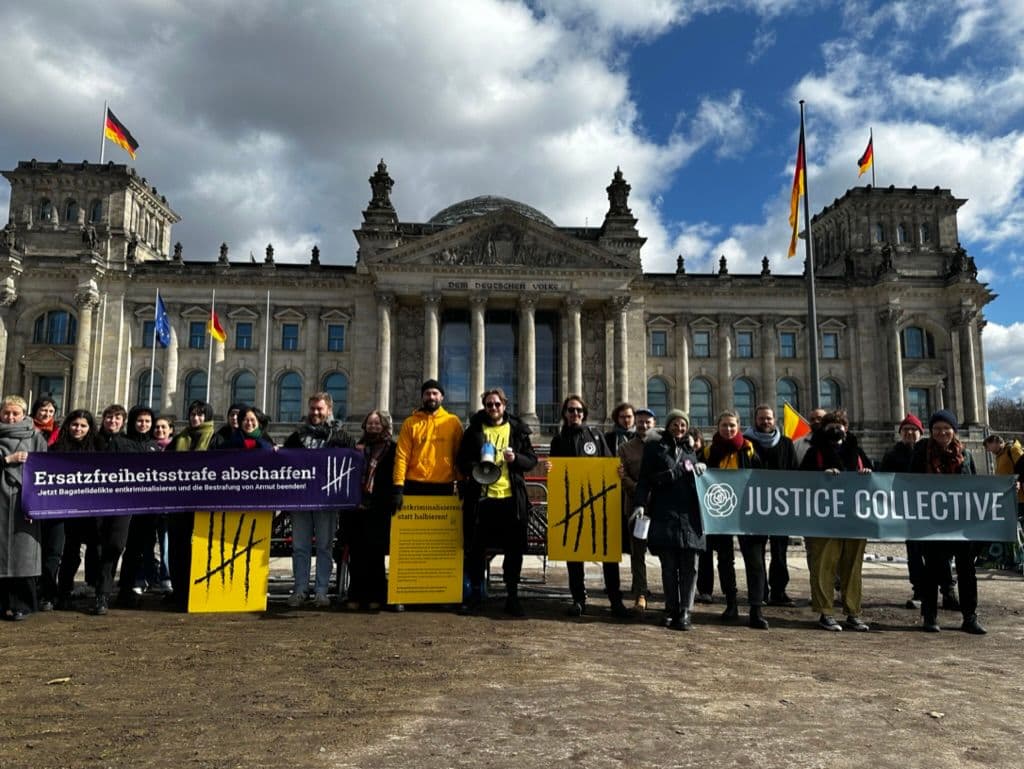
Jailing people for unpaid fines is about more than punishing poverty
Carmen Grimm, Bündnis zur Abschaffung der Ersatzfreiheitsstrafe
In Germany, people are incarcerated every day because they cannot pay a fine. Critics of this practice known as “Ersatzfreiheitsstrafe” are in agreement that a person’s economic status should not determine the severity of their sentence. The Coalition for the Abolition of Debtor’s Prisons agrees with this view – and urges critics to take a broader view attentive to the links between poverty and racism.

Refugees in Germany: The omnipresent border regime
Britta Rabe, Grundrechtekomitee
Even after surviving perilous journeys to reach the EU – which can include pushbacks, beatings, and torture – refugees face an exclusionary system within Fortress Europe that makes their arrival difficult or even impossible. The EU border regime extends all the way into Germany, permeating society invisibly yet tangibly for those who are excluded.