Case 1
| Case Number | 1 |
| Charge | Fare Evasion |
| Defense Attorney Present | No |
| Interpreter Present | Yes |
| Racialized Person | Yes |
| Outcome | Fine |
In this case, a woman with unclear residency and work permit status is tried in an accelerated procedure for three counts of fare evasion. Despite her financial hardship and lack of legal representation, the court imposes a hefty fine. The woman is subjected to repeated questioning about why she came to and resides in Germany, legally irrelevant to decide the case at hand.
Mobility should be a basic right, not a privilege, meaning that the defendant should not be criminalized for riding public transport without a ticket in the first place. By imposing a fine that clearly exceeds the defendant’s means, the court effectively criminalizes poverty and most likely exacerbates the very conditions that led to the offense. The court turns the woman’s inability to pay for a ticket into a question of morality, even accusing her of being a bad mother, which is a stereotype that racialized women specifically are confronted with regularly in courts, according to our observations. For the defendant, the conviction could also affect her ability to stay in the country. Punishment thus acts to enforce Germany’s border regime—and this judge appears to be a willing enforcer.
The accused woman has an interpreter but no legal representation. Throughout the trial, the judge questions her about her reasons for coming to and staying in Germany, despite this being irrelevant to the charges. The woman says that she receives some social benefits for herself and her children, and that a local social work organization assists her in managing her debts, including those from previous fare evasion convictions.
The judge appears skeptical about the woman’s story, questioning how she manages without speaking German and criticizes her for this. The woman explains that there is someone at the social work organization who helps her and will also assist her in buying a monthly ticket. She expresses willingness to pay the fine in installments, seemingly to show cooperation, but the court seems unmoved by her efforts. The judge reprimands her for her supposed moral “failings”, stating that she should not use public transport when she has debts. In his plea, the prosecutor announces that this will be the last time he proposes a fine, threatening the defendant with prison and suggesting that she would not be a good mother if she ended up in prison.
The prosecutor proposes a fine of 90 days at €10 each. The judge imposes 90 days but increases the daily rate to €15, adding up to a total fine of €1,350.
Cases from our archive
Case 39
A young woman experiencing homelessness is sentenced to 90 days of fine payment for supplying drugs. The conviction will not appear on her Certificate of Good Conduct (Führungszeugnis), which was important to her, but the court punishes her with a high fine even as it acknowledges she was supplying drugs because of her poverty.
Case 38
This case concerned a person currently serving a prison sentence being found with a small quantity of cannabis, an amount that would usually not be prosecuted in Berlin. The person is brought to the court from the prison to stand trial and is sentenced to a €30 fine.
Case 37
A white defendant with access to private counsel is sentenced to a fine for possession of 15 small bags of cannabis, with a total amount of cannabis above the legal threshold for a “low quantity” (nicht geringe Menge). The court accepts her account that the cannabis was for personal use, and justifies the relatively mild sentence with a favorable assessment of the defendant living a “normal bourgeois life”.
Case 36
In a case heard shortly before the 2024 law change that legalized certain forms of cultivation, possession, and acquisition of cannabis in Germany, a young man is accused of selling cannabis via car delivery. Despite the relatively low quantity of cannabis found and the person having childcare responsibilities and financial difficulties, the prosecution recommends a sentence of over a year in prison. In the end, the judge imposes a long probation sentence, severe in light of the impending opening of the cannabis market.
Perspectives

Structures of Anti-Roma Racism: An interview with Amaro Foro’s Valerie Laukat
Justice Collective
Courtwatching often reveals the deep-rooted structures of anti-Roma racism in German public institutions and society. In this interview, we find out more about how anti-Roma racism is embedded in broader structures of exploitation and exclusion – and how to work towards transformative change.

Criminalized: The Anti-Migration Debate Fuels and Legitimizes Systemic Racism
Anthony Obst, Justice Collective
Fueled by media coverage of isolated violent incidents, a troubling consensus has emerged that presents increasingly severe law-and-order measures as the only solution to perceived insecurity supposedly caused by immigration. This obscures the violent realities of racist criminalization.
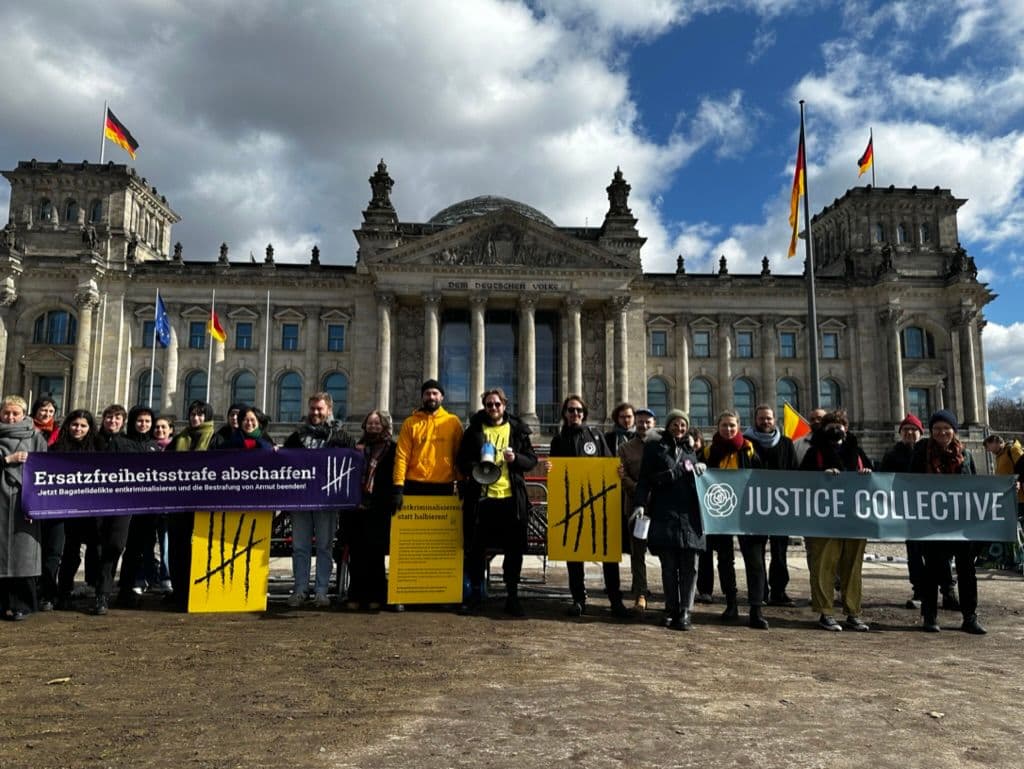
Jailing people for unpaid fines is about more than punishing poverty
Carmen Grimm, Bündnis zur Abschaffung der Ersatzfreiheitsstrafe
In Germany, people are incarcerated every day because they cannot pay a fine. Critics of this practice known as “Ersatzfreiheitsstrafe” are in agreement that a person’s economic status should not determine the severity of their sentence. The Coalition for the Abolition of Debtor’s Prisons agrees with this view – and urges critics to take a broader view attentive to the links between poverty and racism.

Refugees in Germany: The omnipresent border regime
Britta Rabe, Grundrechtekomitee
Even after surviving perilous journeys to reach the EU – which can include pushbacks, beatings, and torture – refugees face an exclusionary system within Fortress Europe that makes their arrival difficult or even impossible. The EU border regime extends all the way into Germany, permeating society invisibly yet tangibly for those who are excluded.